GitHub - addyosmani/agent-skills: Production-grade engineering skills for AI coding agents.
Agent Skills Production-grade engineering skills for AI coding agents. Skills encode the workflows, quality gates, and best practices that senior engineers use when building software. These ones are packaged so AI agents follow them consistently across every
社区作者 · zZz
它解决什么问题
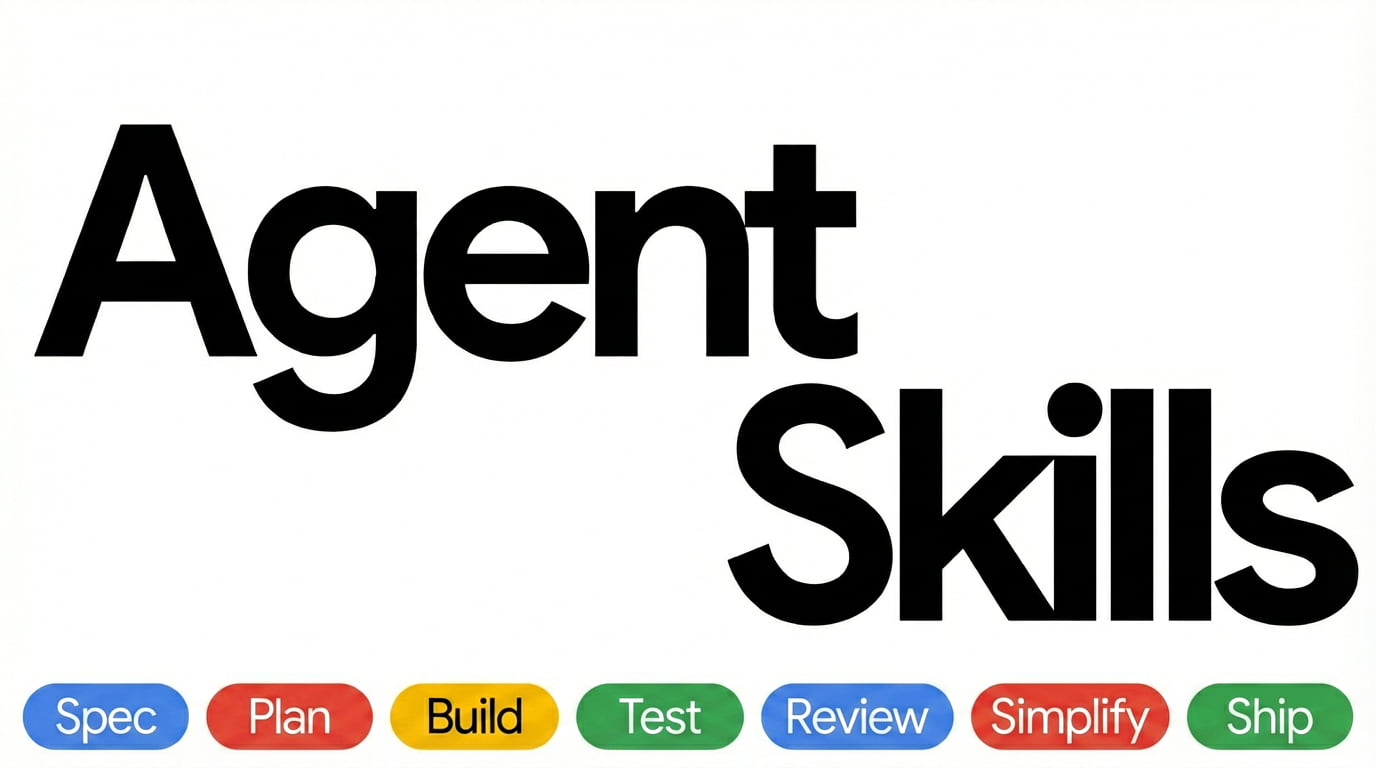
Agent Skills
Production-grade engineering skills for AI coding agents.
Skills encode the workflows, quality gates, and best practices that senior engineers use when building software. These ones are packaged so AI agents follow them consistently across every phase of development.
DEFINE PLAN BUILD VERIFY REVIEW SHIP ┌──────┐ ┌──────┐ ┌──────┐ ┌──────┐ ┌──────┐ ┌──────┐ │ Idea │ ───▶ │ Spec │ ───▶ │ Code │ ───▶ │ Test │ ───▶ │ QA │ ───▶ │ Go │ │Refine│ │ PRD │ │ Impl │ │Debug │ │ Gate │ │ Live │ └──────┘ └──────┘ └──────┘ └──────┘ └──────┘ └──────┘ /spec /plan /build /test /review /ship
Commands
9 slash commands that map to the development lifecycle. Each one activates the right skills automatically.
What you're doing Command Key principle
Define what to build /spec Spec before code
Plan how to build it /plan Small, atomic tasks
Build incrementally /build One slice at a time
Prove it works /test Tests are proof
Set the quality bar/constraints Decide it once, enforce it everywhere
Review before merge /review Improve code health
Audit web performance /webperf Measure before you optimize
Simplify the code /code-simplify Clarity over cleverness
Ship to production /ship Faster is safer
Want fewer manual steps once the spec exists? /build auto generates the plan and implements every task in a single approved pass — you approve the plan once, then it runs autonomously.
It removes the human stepping between tasks, not the verification: every task is still test-driven and committed individually, and it pauses on failures or risky steps.
Skills also activate automatically based on what you're doing — designing an API triggers api-and-interface-design , building UI triggers frontend-ui-engineering , and so on.
Quick Start
Fastest path — any agent, one command. The open skills CLI installs into 70+ agents (Claude Code, Cursor, Codex, Copilot, Cline, and more):
npx skills add addyosmani/agent-skills # install all 25 skillsnpx skills add addyosmani/agent-skills --list # browse before installingOr grab individual skills:
npx skills add addyosmani/agent-skills --skill code-review-and-quality # five-axis review before mergenpx skills add addyosmani/agent-skills --skill interview-me # requirements interrogation, one question at a timenpx skills add addyosmani/agent-skills --skill test-driven-development # red-green-refactor, enforcedInstalling one skill? A per-skill npx install copies only skills/<name>/ , not the repo-level references/ directory. The skill still works, but paths to supplementary shared checklists are unavailable.
Use a whole-repo integration, clone the repository, or copy the needed checklist into a references/ directory inside the installed skill. This portability gap is tracked in #361 .
Prefer a native integration? Pick your tool below.
Claude Code (recommended) Marketplace install:
/plugin marketplace add addyosmani/agent-skills /plugin install agent-skills@addy-agent-skills
SSH errors? The marketplace clones repos via SSH. If you don't have SSH keys set up on GitHub, either add your SSH key or use the full HTTPS URL to force HTTPS cloning during the marketplace-add step:
/plugin marketplace add https://github.com/addyosmani/agent-skills.git /plugin install agent-skills@addy-agent-skills
If /plugin install still fails with [email protected]: Permission denied (publickey) on Windows or macOS, the recommended workaround is to configure Git once to rewrite GitHub SSH URLs to HTTPS for subprocess clones:
git config --global url. " https://github.com/ " .insteadOf [email protected]:Local / development:
git clone https://github.com/addyosmani/agent-skills.gitclaude --plugin-dir /path/to/agent-skills
Cursor Put workflow skills under .cursor/skills/ (sync from agent-skills/skills/ ) and short policies in .cursor/rules/*.mdc — do not paste full skills into rules. See docs/cursor-setup.md .
Antigravity CLI Install as a native plugin for skills and subagents. In affected Antigravity CLI releases, legacy command TOMLs are reported as converted but their wrapper commands are not discoverable; invoke the underlying namespaced skills directly.
See docs/antigravity-setup.md .
Install from the repo:
agy plugin install https://github.com/addyosmani/agent-skills.git
Install from a local clone:
git clone https://github.com/addyosmani/agent-skills.gitagy plugin install ./agent-skills
Gemini CLI Install as native skills for auto-discovery, or add to GEMINI.md for persistent context. See docs/gemini-cli-setup.md .
Install from the repo:
gemini skills install https://github.com/addyosmani/agent-skills.git --path skills
Install from a local clone:
gemini skills install ./agent-skills/skills/
Windsurf Add skill contents to your Windsurf rules configuration. See docs/windsurf-setup.md .
OpenCode Copy skills to .opencode/skills/ (or ~/.config/opencode/skills/ ), add a project-local AGENTS.md , and use the built-in skill tool for agent-driven execution. Optional slash commands can be added under .opencode/commands/ .
See docs/opencode-setup.md .
GitHub Copilot Use agent definitions from agents/ as Copilot personas and skill content in .github/copilot-instructions.md . See docs/copilot-setup.md .
Using the standalone copilot CLI? Install it as a plugin — see docs/copilot-cli-setup.md .
Kiro IDE & CLI Skills for Kiro reside under ".kiro/skills/" and can be stored under Project or Global level. Kiro also supports Agents.md. See Kiro docs at https://kiro.dev/docs/skills/
Codex Install as a native Codex plugin (Codex CLI v0.122+):
codex plugin marketplace add addyosmani/agent-skills codex plugin add agent-skills@agent-skills
The first command registers the marketplace; the second installs the plugin. Codex reads the root skills/ directory directly through .codex-plugin/plugin.json . Once installed, invoke skills in chat using @ (e.g., @spec-driven-development ).
See docs/codex-setup.md for local installation and troubleshooting.
Command Code Install natively with the built-in cmd skills command. Command Code clones the repo, discovers every SKILL.md , and installs into .commandcode/skills/ :
cmd skills add addyosmani/agent-skills # pick skills to install (project) cmd skills add addyosmani/agent-skills --global # install for all projects (~/.commandcode/skills/) cmd skills add addyosmani/agent-skills -s spec-driven-development # install a specific skill
Installed skills show up in the TUI slash menu, e.g. /spec-driven-development . See docs/commandcode-setup.md .
Other Agents Skills are plain Markdown - they work with any agent that accepts system prompts or instruction files. See docs/getting-started.md .
Adoption
Already installed? How you roll the pack out depends on your codebase. The Adoption Guide covers two paths: the full lifecycle from day one for a greenfield project, or an incremental, verification-first rollout for an established codebase.
All 25 Skills
The commands above are entry points. The pack includes 25 skills total — 24 lifecycle skills plus the using-agent-skills meta-skill. Each skill is a structured workflow with steps, verification gates, and anti-rationalization tables. You can also reference any skill directly.
Meta - Discover which skill applies
Skill What It Does Use When
using-agent-skills Maps incoming work to the right skill workflow and defines shared operating rules Starting a session or deciding which skill applies
Define - Clarify what to build
Skill What It Does Use When
interview-me One-question-at-a-time interview that extracts what the user actually wants instead of what they think they should want, until ~95% confidence The ask is underspecified, or the user invokes "interview me" / "grill me"
idea-refine Structured divergent/convergent thinking to turn vague ideas into concrete proposals You have a rough concept that needs exploration
spec-driven-development Write a PRD covering objectives, commands, structure, code style, testing, and boundaries before any code Starting a new project, feature, or significant change
constraint-driven-development Interviews you for a quality bar with sane default thresholds, writes CONSTRAINTS.
md, places each check by cost, and catches agents silencing checks or skipping tests to get green No standards are written down, or an agent is producing more than anyone reads
Plan - Break it down
Skill What It Does Use When
planning-and-task-breakdown Decompose specs into small, verifiable tasks with acceptance criteria and dependency ordering You have a spec and need implementable units
Build - Write the code
Skill What It Does Use When
incremental-implementation Thin vertical slices - implement, test, verify, commit. Feature flags, safe defaults, rollback-friendly changes Any change touching more than one file
test-driven-development Red-Green-Refactor, test pyramid (80/15/5), test sizes, DAMP over DRY, Beyonce Rule, browser testing Implementing logic, fixing bugs, or changing behavior
context-engineering Feed agents the right information at the right time - rules files, context packing, MCP integrations Starting a session, switching tasks, or when output quality drops
source-driven-development Ground every framework decision in official documentation - verify, cite sources, flag what's unverified You want authoritative, source-cited code for any framework or library
doubt-driven-development Adversarial fresh-context review of every non-trivial decision in-flight - CLAIM → EXTRACT → DOUBT → RECONCILE → STOP, with optional user-authorized cross-model escalation Stakes are high (production, security, irreversible), working in unfamiliar code, or a confident output is cheaper to verify now than to debug later
frontend-ui-engineering Component architecture, design systems, state management, responsive design, WCAG 2.1 AA accessibility Building or modifying user-facing interfaces
api-and-interface-design Contract-first design, Hyrum's Law, One-Version Rule, error semantics, boundary validation Designing APIs, module boundaries, or public interfaces
Verify - Prove it works
Skill What It Does Use When
browser-testing-with-devtools Chrome DevTools MCP for live runtime data - DOM inspection, console logs, network traces, performance profiling Building or debugging anything that runs in a browser
debugging-and-error-recovery Five-step triage: reproduce, localize, reduce, fix, guard. Stop-the-line rule, safe fallbacks Tests fail, builds break, or behavior is unexpected
Review - Quality gates before merge
Skill What It Does Use When
code-review-and-quality Five-axis review, change sizing (~100 lines), severity labels (Nit/Optional/FYI), review speed norms, splitting strategies Before merging any change
code-simplification Chesterton's Fence, Rule of 500, reduce complexity while preserving exact behavior Code works but is harder to read or maintain than it should be
security-and-hardening OWASP Top 10 prevention, auth patterns, secrets management, dependency auditing, three-tier boundary system Handling user input, auth, data storage, or external integrations
performance-optimization Measure-first approach - Core Web Vitals targets, profiling workflows, bundle analysis, anti-pattern detection Performance requirements exist or you suspect regressions
Ship - Deploy with confidence
Skill What It Does Use When
git-workflow-and-versioning Trunk-based development, atomic commits, change sizing (~100 lines), the commit-as-save-point pattern Making any code change (always)
ci-cd-and-automation Shift Left, Faster is Safer, feature flags, quality gate pipelines, failure feedback loops Setting up or modifying build and deploy pipelines
deprecation-and-migration Code-as-liability mindset, compulsory vs advisory deprecation, migration patterns, zombie code removal Removing old systems, migrating users, or sunsetting features
documentation-and-adrs Architecture Decision Records, API docs, inline documentation standards - document the why Making architectural decisions, changing APIs, or shipping features
observability-and-instrumentation Structured logging, RED metrics, OpenTelemetry tracing, symptom-based alerting - instrument as you build Adding telemetry, or shipping anything that runs in production
shipping-and-launch Pre-launch checklists, feature flag lifecycle, staged rollouts, rollback procedures, monitoring setup Preparing to deploy to production
Agent Personas
Pre-configured specialist personas for targeted reviews:
Agent Role Perspective
code-reviewer Senior Staff Engineer Five-axis code review with "would a staff engineer approve this?" standard
test-engineer QA Specialist Test strategy, coverage analysis, and the Prove-It pattern
security-auditor Security Engineer Vulnerability detection, threat modeling, OWASP assessment
web-performance-auditor Web Performance Engineer Core Web Vitals audit with Quick/Deep modes and a metric-honesty rule; run it via /webperf
See docs/agents.md for the decision matrix, orchestration rules, and how personas compose with skills and slash commands.
Reference Checklists
Quick-reference material that skills pull in when needed:
Reference Covers
definition-of-done.md Project-wide standing bar every change clears, contrasted with per-task acceptance criteria
testing-patterns.md Test structure, naming, mocking, React/API/E2E examples, anti-patterns (JavaScript/TypeScript)
security-checklist.md Pre-commit checks, auth, input validation, headers, CORS, OWASP Top 10
performance-checklist.md Core Web Vitals targets, frontend/backend checklists, measurement commands
accessibility-checklist.md Keyboard nav, screen readers, visual design, ARIA, testing tools
observability-checklist.md On-call questions, structured logging, RED/USE metrics, tracing, symptom-based alerting, pre-launch gate
orchestration-patterns.md Endorsed multi-persona orchestration patterns, anti-patterns, and the "personas don't invoke personas" rule
How Skills Work
Every skill follows a consistent anatomy:
┌─────────────────────────────────────────────────┐ │ SKILL.md │ │ │ │ ┌─ Frontmatter ─────────────────────────────┐ │ │ │ name: lowercase-hyphen-name │ │ │ │ description: Guides agents through [task].
│ │ │ │ Use when… │ │ │ └───────────────────────────────────────────┘ │ │ Overview → What this skill does │ │ When to Use → Triggering conditions │ │ Process → Step-by-step workflow │ │ Rationalizations → Excuses + rebuttals │ │ Red Flags → Signs something's wrong │ │ Verification → Evidence requirements │ └─────────────────────────────────────────────────┘
Key design choices:
- Process, not prose. Skills are workflows agents follow, not reference docs they read. Each has steps, checkpoints, and exit criteria.
- Anti-rationalization. Every skill includes a table of common excuses agents use to skip steps (e.g., "I'll add tests later") with documented counter-arguments.
- Verification is non-negotiable. Every skill ends with evidence requirements - tests passing, build output, runtime data. "Seems right" is never sufficient.
- Progressive disclosure. The SKILL.md is the entry point. Supporting references load only when needed, keeping token usage minimal.
Project Structure
The portable core stays in shared directories. Host-specific paths are native discovery conventions, not branding aliases; renaming or merging them would break the tools that scan those exact locations.
Layer / consumer Repository paths Purpose
Shared workflow core skills/ (25 skills) Portable SKILL.md workflows used by every integration
Shared review material agents/ (4 personas), references/ (7 checklists) Specialist reviewers and pack-level checklists carried by whole-repo installs
Claude Code adapter .claude/commands/ (9 commands), .claude-plugin/ , hooks/ Slash-command wrappers, marketplace metadata, and lifecycle hooks
Gemini CLI adapter .gemini/commands/ (9 commands) Gemini-native TOML command wrappers
Antigravity CLI adapter commands/ (9 commands), plugin.json Legacy TOML wrappers and the root plugin manifest; see the known wrapper limitation
Codex adapter .codex-plugin/ , .agents/plugins/ Codex plugin metadata and marketplace registration; Codex consumes skills/ directly
GitHub Copilot CLI adapter plugin.json Root plugin metadata; Copilot CLI discovers skills/ by convention and does not register the lifecycle wrappers
Contributor tooling scripts/ (13 scripts), evals/ (25 case files), .github/workflows/ Validation, routing evals, and CI
Documentation docs/ Universal guidance and per-tool setup guides
Tools without a checked-in adapter directory install or copy the shared skills/ core into their own native location. The Quick Start links the setup guide for each supported host.
Why Agent Skills?
AI coding agents default to the shortest path - which often means skipping specs, tests, security reviews, and the practices that make software reliable. Agent Skills gives agents structured workflows that enforce the same discipline senior engineers bring to production code.
Each skill encodes hard-won engineering judgment: when to write a spec, what to test, how to review, and when to ship. These aren't generic prompts - they're the kind of opinionated, process-driven workflows that separate production-quality work from prototype-quality work.
Skills bake in best practices from Google's engineering culture — including concepts from Software Engineering at Google and Google's engineering practices guide .
You'll find Hyrum's Law in API design, the Beyonce Rule and test pyramid in testing, change sizing and review speed norms in code review, Chesterton's Fence in simplification, trunk-based development in git workflow, Shift Left and feature flags in CI/CD, and a dedicated deprecation skill treating code as a liability.
These aren't abstract principles — they're embedded directly into the step-by-step workflows agents follow.
How it compares
Wondering how this stacks up against Superpowers or Matt Pocock's skills ? See docs/comparison.md for an honest, side-by-side look at how the three are shaped differently and when to reach for each — including a link to a controlled head-to-head experiment .
Contributing
Skills should be specific (actionable steps, not vague advice), verifiable (clear exit criteria with evidence requirements), battle-tested (based on real workflows), and minimal (only what's needed to guide the agent).
See docs/skill-anatomy.md for the format specification and CONTRIBUTING.md for guidelines.
Team
agent-skills is built and maintained by:
Name GitHub Role
Addy Osmani @addyosmani Creator
Federico Bartoli @federicobartoli Collaborator
Joan León @nucliweb Collaborator
License
MIT - use these skills in your projects, teams, and tools.
— 本文由 AI 根据公开来源辅助整理,命令、版本与许可证请在使用前到原始页面复核。
安装 / 开始使用
Quick Start Fastest path — any agent, one command. The open skills CLI installs into 70+ agents (Claude Code, Cursor, Codex, Copilot, Cline, and more):
npx skills add addyosmani/agent-skills # install all 25 skillsnpx skills add addyosmani/agent-skills --list # browse before installingOr grab individual skills:
npx skills add addyosmani/agent-skills --skill code-review-and-quality # five-axis review before mergenpx skills add addyosmani/agent-skills --skill interview-me # requirements interrogation, one question at a timenpx skills add addyosmani/agent-skills --skill test-driven-development # red-green-refactor, enforcedInstalling one skill? A per-skill npx install copies only skills/<name>/ , not the repo-level references/ directory. The skill still works, but paths to supplementary shared checklists are unavailable.
Use a whole-repo integration, clone the repository, or copy the needed checklist into a references/ directory inside the installed skill. This portability gap is tracked in #361 . Prefer a native integration? Pick your tool below.
Claude Code (recommended) Marketplace install: /plugin marketplace add addyosmani/agent-skills /plugin install agent-skills@addy-agent-skills SSH errors? The marketplace clones repos via SSH.
If you don't have SSH keys set up on GitHub, either add your SSH key or use the full HTTPS URL to force HTTPS cloning during the marketplace-add step: /plugin marketplace add https://github.com/addyosmani/agent-skills.
git /plugin install agent-skills@addy-agent-skills If /plugin install still fails with git@github.
com: Permission denied (publickey) on Windows or macOS, the recommended workaround is to configure Git once to rewrite GitHub SSH URLs to HTTPS for subprocess clones:
git config --global url. " https://github.com/ " .insteadOf [email protected]:Local / development:
git clone https://github.com/addyosmani/agent-skills.gitclaude --plugin-dir /path/to/agent-skills Cursor Put workflow skills under .cursor/skills/ (sync from agent-skills/skills/ ) and short policies in .cursor/rules/*.mdc — do not paste full skills into rules. See docs/cursor-setup.md .
Antigravity CLI Install as a native plugin for skills and subagents. In affected Antigravity CLI releases, legacy command TOMLs are reported as converted but their wrapper commands are not discoverable; invoke the underlying namespaced skills directly.
See docs/antigravity-setup.md . Install from the repo: agy plugin install https://github.com/addyosmani/agent-skills.git Install from a local clone:
git clone https://github.com/addyosmani/agent-skills.gitagy plugin install ./agent-skills Gemini CLI Install as native skills for auto-discovery, or add to GEMINI.md for persistent context. See docs/gemini-cli-setup.md . Install from the repo: gemini skills install https://github.com/addyosmani/agent-skills.
git --path skills Install from a local clone: gemini skills install ./agent-skills/skills/ Windsurf Add skill contents to your Windsurf rules configuration. See docs/windsurf-setup.md . OpenCode Copy skills to .opencode/skills/ (or ~/.
config/opencode/skills/ ), add a project-local AGENTS.md , and use the built-in skill tool for agent-driven execution. Optional slash commands can be added under .opencode/commands/ . See docs/opencode-setup.md .
GitHub Copilot Use agent definitions from agents/ as Copilot personas and skill content in .github/copilot-instructions.md . See docs/copilot-setup.md . Using the standalone copilot CLI? Install it as a plugin — see docs/copilot-cli-setup.md .
Kiro IDE & CLI Skills for Kiro reside under ".kiro/skills/" and can be stored under Project or Global level. Kiro also supports Agents.md. See Kiro docs at https://kiro.dev/docs/skills/ Codex Install as a native Codex plugin (Codex CLI v0.
122+): codex plugin marketplace add addyosmani/agent-skills codex plugin add agent-skills@agent-skills The first command registers the marketplace; the second installs the plugin. Codex reads the root skills/ directory directly through .codex-plugin/plugin.
json . Once installed, invoke skills in chat using @ (e.g., @spec-driven-development ). See docs/codex-setup.md for local installation and troubleshooting. Command Code Install natively with the built-in cmd skills command.
Command Code clones the repo, discovers every SKILL.md , and installs into .commandcode/skills/ : cmd skills add addyosmani/agent-skills # pick skills to install (project) cmd skills add addyosmani/agent-skills --global # install for all projects (~/.
commandcode/skills/) cmd skills add addyosmani/agent-skills -s spec-driven-development # install a specific skill Installed skills show up in the TUI slash menu, e.g. /spec-driven-development . See docs/commandcode-setup.md .
Other Agents Skills are plain Markdown - they work with any agent that accepts system prompts or instruction files. See docs/getting-started.md . Adoption Already installed? How you roll the pack out depends on your codebase.
The Adoption Guide covers two paths: the full lifecycle from day one for a greenfield project, or an incremental, verification-first rollout for an established codebase. All 25 Skills The commands above are entry points.
The pack includes 25 skills total — 24 lifecycle skills plus the using-agent-skills meta-skill. Each skill is a structured workflow with steps, verification gates, and anti-rationalization tables. You can also reference any skill directly.
Meta - Discover which skill applies Skill What It Does Use When using-agent-skills Maps incoming work to the right skill workflow and defines shared operating rules Starting a session or deciding which skill applies Define - Clarify what to build Skill What It Does Use When interview-me One-question-at-a-time interview that extracts what the user actually wants instead of what they think they should want, until ~95% confidence The ask is underspecified, or the user invokes "interview me" / "grill me" idea-refine Structured divergent/convergent thinking to turn vague ideas into concrete proposals You have a rough concept that needs exploration spec-driven-development Write a PRD covering objectives, commands, structure, code style, testing, and boundaries before any code Starting a new project, feature, or significant change constraint-driven-development